|
|
A short history of Trowbridge's Park Bandstand. |
|
|
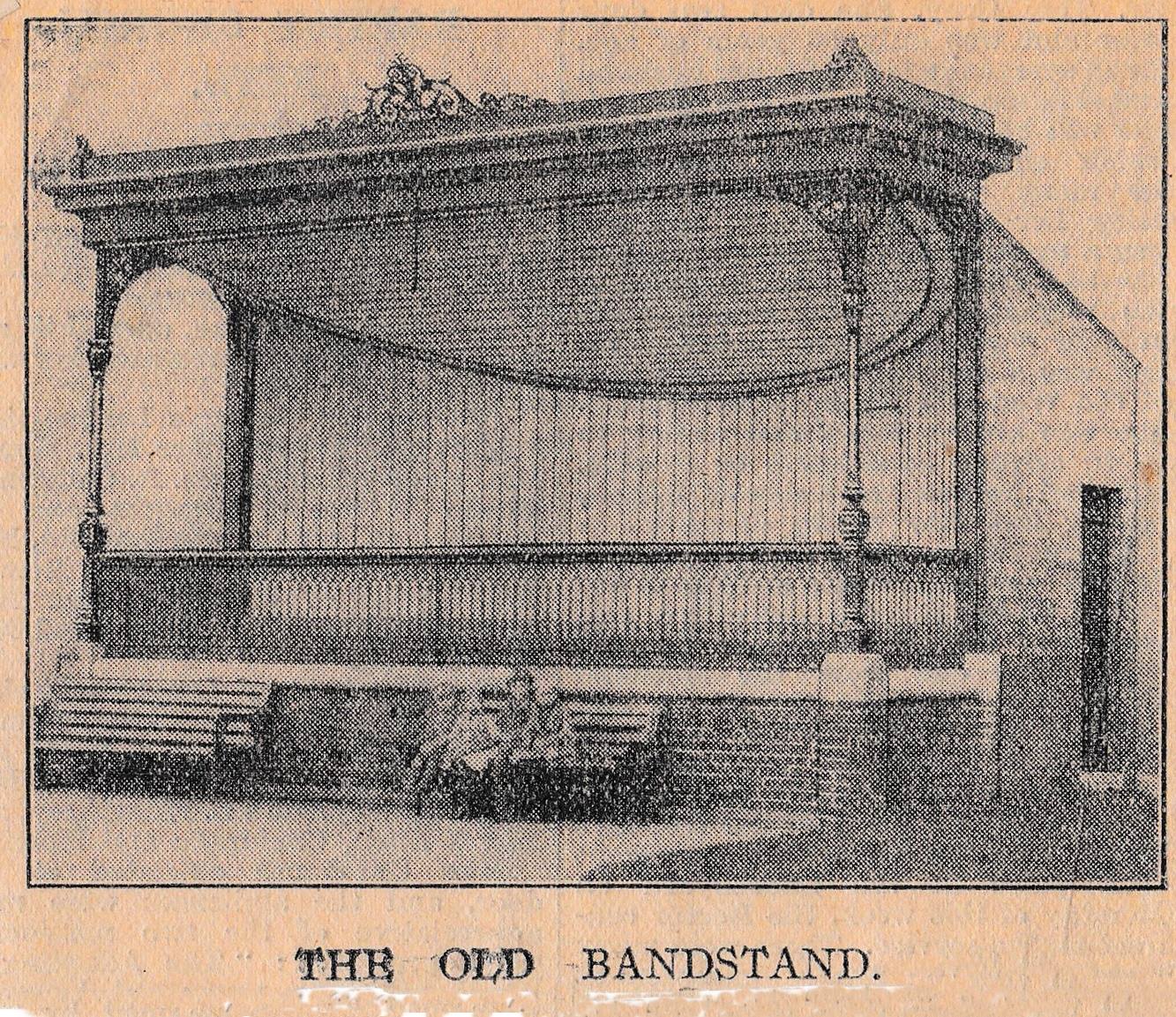
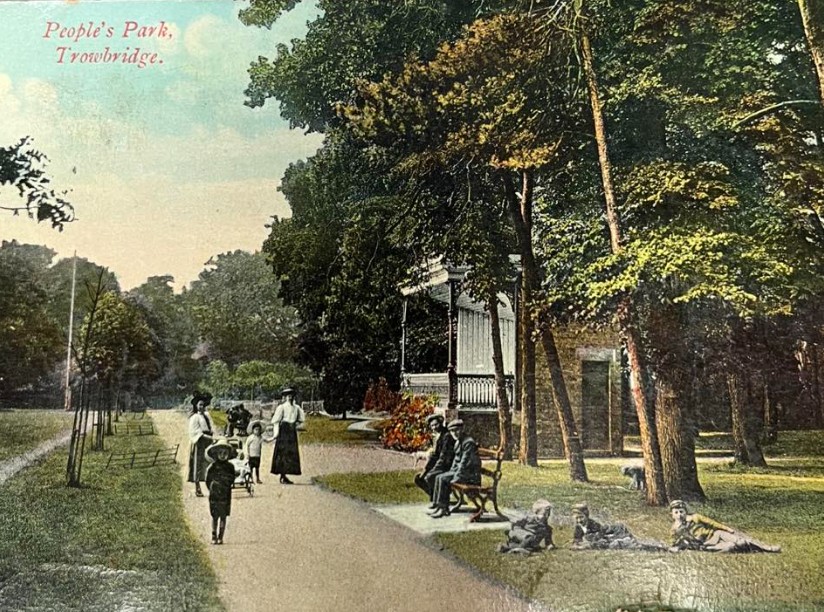
In order to understand the history of the Bandstand, it is first important to appreciate the history of the Town Park in which it stands. The early history of the land that would become Trowbridge’s Town Park is interwoven (an apt term, considering the town’s strong association with the wool weaving industry) with the history of the site now occupied by the Old Town Hall. In the 16th and 17th centuries, the site of the Old Town Hall was known as Hall's Place and was owned by the Hall family. The grand house that then occupied this site was one of only three prominent stone buildings in the town centre, the others being St James's Church and the Market Cross. The property passed from the Hall family to the Langford family before being purchased in 1812 by William Stancomb, a prosperous local wool merchant and mill owner. It was during William Stancomb’s ownership that the house became officially known as The Limes. The arrival of the railway in Trowbridge in 1848, along with the town’s expansion driven by the cloth, brewing and food industries, fueled rapid urban population growth. In 1860, Stancomb used land adjacent to his home to construct the town's first Market Hall and large cattle market was subsequently established behind the Market Hall on land that now forms the boundary of Trowbridge Park. In 1884, William Stancomb made the generous decision to open his grounds to the people of Trowbridge. At that time, the town was a thriving manufacturer of world renowned woolen cloth and clothing. The skyline then would have looked very different than today. In every direction stood the chimney stacks of the mills that drove the local economy. Visible from these open grounds would have been Ashton Mill to the south, Court Mill to the east, Home Mill to the west with Studley and Innox Mills beyond, and Silver Street and Yerbury Mills to the north. Amid this heavily industrial landscape this welcome expanse of green space, made available to the people of Trowbridge by William Stancomb, quickly became a popular retreat. The area offered local workers and their families a place to relax and escape, if only for a time, from the demands and pressures of industrial life. Then, in 1887, the Local Board of Health started to look for a site for a grand municipal building. The site of William Stamcom’s grand house became the front runner and Sir William Roger Brown, a wealthy cloth merchant and arguably Trowbridge's greatest philanthropist, funded a project to build such a building, coinciding as a tribute to Queen Victoria's Golden Jubilee. The Limes was therefore purchased for £20,000 and demolished to make way for the new Town Hall, now the Old Town Hall, which opened in 1889. William Brown, along with two other local benefactors (a Mr Walker and Mr Hayward) now led the efforts to secure the park's future. Together they combined their own financial contribution with £1,337 raised through a public subscription and purchased the land outright and free of debt for the people of Trowbridge. The completion of the Town Hall therefore coincided closely with the formal establishment of the adjoining public park. In the years that followed, the park was gradually extended towards the River Biss through further donations from prominent local benefactors, eventually by the beginning of the 20th century reaching the 12 acres that we enjoy today. Following the First World War, the park was chosen as the permanent site for the town’s War Memorial, thus becoming a focal point for community remembrance. With funds raised by wealthy businessmen and donations from local businesses, like Ushers, the memorial, featuring a lone soldier standing with fixed bayonet atop a stone plinth, was unveiled in 1923 and commemorates the 289 men and women of Trowbridge who lost their lives during the First World War. Sadly, the conflict that many believed would be "the war to end all wars" did not prove to be so. Following the Second World War, a further 102 names were added to the memorial, ensuring their sacrifice would also be remembered. As part of the original memorial dedication, families of those who had lost loved ones were invited to plant an avenue of Cornish elm trees. Arranged in three rows, the avenue extended southwards from the memorial towards the lower field, creating a living memorial to the fallen. Sadly, the devastating outbreak of Dutch Elm Disease during the late 1960s and early 1970s that destroyed tens of thousands of ancient elm trees across England did not spare the elms of Trowbridge Park and eventually these too had to be felled. The lost elms were replaced in the 1980s by Lime trees that follow the same alignment as the original avenue. It would be fitting to think that these Lime trees were chosen because of The Limes, thus preserving both the landscape and the memory of those whom the original trees were intended to honour. Into the 21st Century, the park continues to serve as a hub for community activity, regularly hosting community events, concerts and fairs. *** .... and so, onto the Bandstand we know today. The original bandstand in the Town Park was a traditional Victorian structure erected following the park's formal opening in 1884, however, by the late 1930s, the structure of this bandstand had suffered from significant decay and it was decided to demolish it as part of a broader effort to modernise the park.
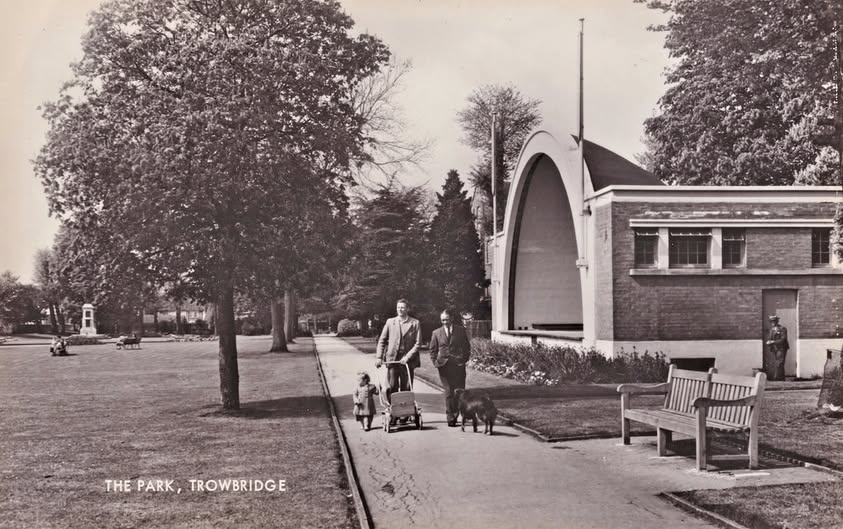
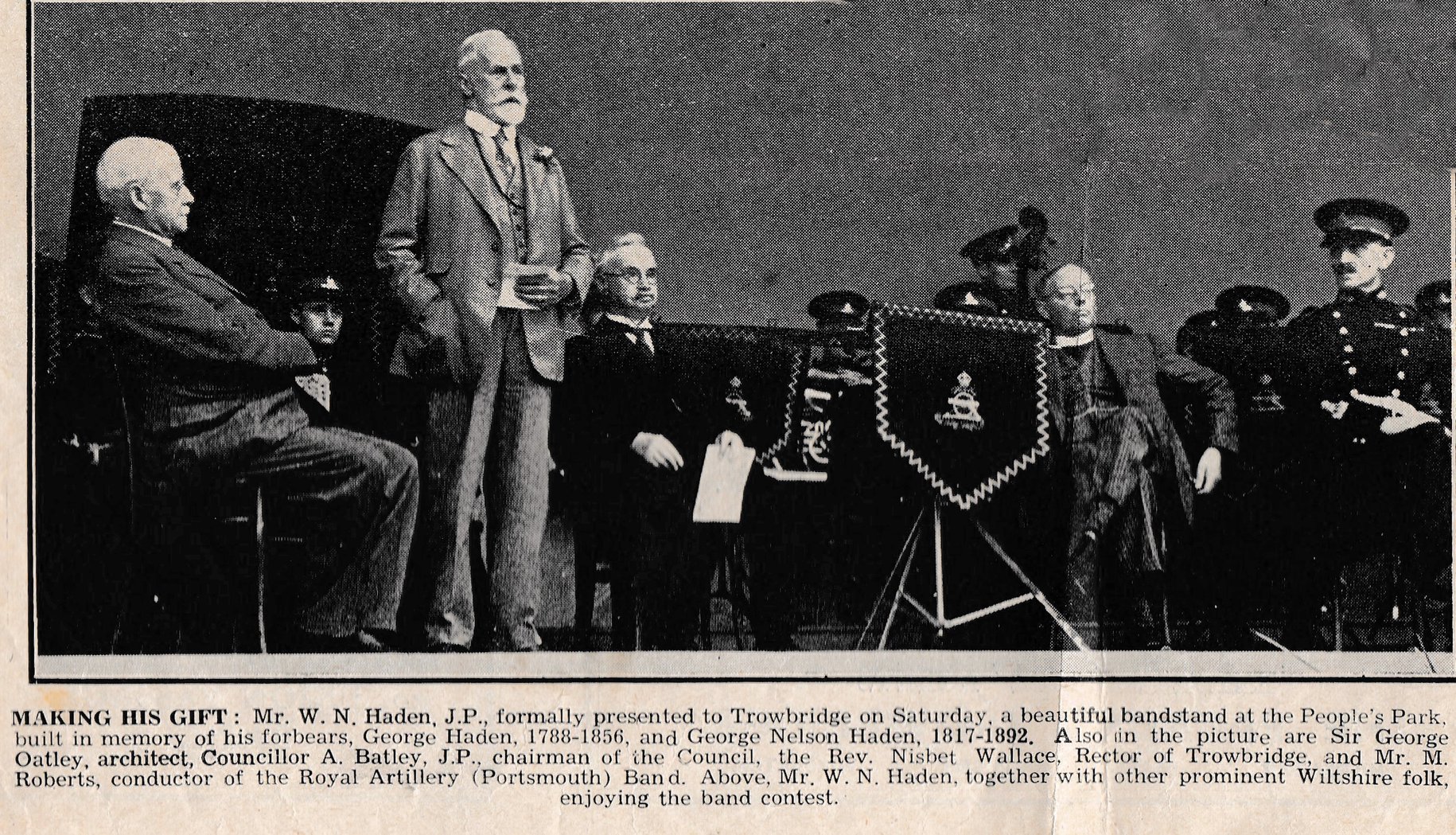
In 1939 local industrialist William Nelson Haden paid for the construction of a new Trowbridge Park Bandstand (the current art deco structure) in the same location as the original structure. The two images below show the original Victorian bandstand on the left and the 1939 art deco bandstand on the right. It is interesting to see how the trees, that were saplings when the photograph of the Victorian structure was taken, have grown into full trees by the time of the second photograph. Also visible in the background of the second photograph, but not in the first, is the town’s War Memorial that was erected after the First World War.
So the current bandstand was commissioned and gifted to the town in 1939 by local industrialist William Nelson Haden (B 1859 - D 1946). You can read more about this man and his family's legacy in Trowbridge by following the Haden link on the right of this page.
Trowbridge's Bandstand a fine example of Art Deco architecture, which is relatively rare for public bandstands in the UK. It was built as part of a broader effort to enhance Trowbridge’s Town Park and provide a dedicated space for musical performances and community events. The shell design was chosen specifically for its parabolic properties, significantly increasing the volume and clarity for audiences gathered on the main lawn. Completed just before the outbreak of the Second World War, the bandstand became a vital site for "Holidays at Home" events, military training and band performances and was intended to maintain public morale during the conflict. Bandstands were popular during this era as they served as focal points for public gatherings, concerts, and other cultural activities, it was key to providing entertainment for the residents, especially following the first world war. Its distinctive Art Deco design, was intended to be both functional and aesthetically pleasing, reflecting the architectural trends of the time. Over the years since its construction, the Bandstand has been used, and continues to be used, for events in the park and is to this day a much loved centre-piece and focal point for events in Trowbridge. Prior to 2014, the Bandstand was maintained by the local authority, initially West Wiltshire District Council, then Wiltshire Council from 2009 following the move to a unitary authority. Service Delegation and Asset Transfer discussions commenced between Wiltshire Council and Trowbridge Town Council in 2013 with the transfer of the Bandstand being completed in 2014. Unfortunately, by the time the transfer was to Trowbridge Town Council was completed the Bandstand already in need of repairs. Initially TTC was able to undertake some minor/cosmetic repairs and security fencing was installed at this time to protect the building from unauthorised access, vandalism and anti-social behaviour. This brings us up to about 2014.... the story from here on belongs to the present day efforts to preserve and conserve the Bandstand. You can read all about that by following the "What work is needed" link on the right side of this page. Return to HOME |
||
|
About the Friends of Trowbridge Bandstand: |
About the Bandstand itself: |
|
|
|
|
|
|
FoTB Documentation. The FoTB is governed by a written Constitution and relies on documented Rules and Policies that dictate how we operate. All our documentation is ISO9001 compliant. You can view the most recent versions of our documentation by clicking HERE. |
Past and present images of the Bandstand Click HERE to view a selection of old and new images of the Bandstand. Do you have photographs of the bandstand, either past or present, that you'd like to share? If so, please send them to us at admin@fotb.org.uk |
|
|
The Friends of Trowbridge Bandstand has applied to the Charity Commission for England and Wales for registration as a charity under the Charities Act 2011 (Application number: 5294277) |
||