|
|
Who was William Nelson Haden? |
|
|
The story of William Nelson Haden is inextricably tied in with the history of the Haden Company itself. Many people will know of Trowbridge as a centre of the woolen industry both before and after the Industrial Revolution of the late 1700s. The town was the centre of woolen cloth production in south-west England in the late 18th and early 19th centuries. Known by the epithet "The Manchester of the South", Trowbridge once hosted forty wool mills and was widely regarded as one of the wealthiest towns in England. What they maybe don’t know about Trowbridge is that there was another industry that grew up in the town in the aftermath of the Industrial Revolution. Haden, a prominent engineering firm with a rich history, began in 1816 when brothers George and James Haden established their engineering company in Trowbridge, Wiltshire. George Haden (1788–1856) was a British engineer, inventor and holder of several patents relating to woollen milling and warm-air heating. He is most known for the design of heating systems for Wilton House, the Houses of Parliament, the British Museum Reading Room and in 1826, at the request of King George IV, Windsor Castle. The Windsor Castle heating system was particularly revolutionary being a pioneering warm-air central heating system. This installation at a royal residence helped cement Haden as an industry leader and the Haden company rapidly grew into an international company specialising in heating, ventilation and plumbing. The partnership evolved over the years, with James Haden retiring in 1855, leading to the formation of George Haden and Son, under George and his son George Nelson Haden.
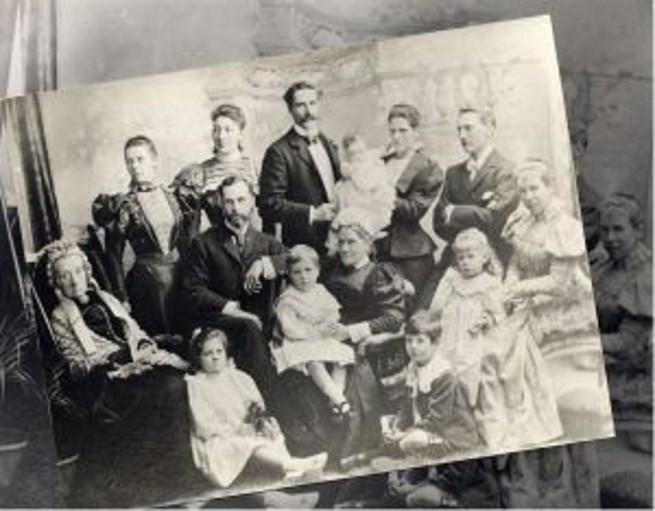
The Haden Family - circa 1900 By 1914 the company was under the direction of William Nelson Haden, J.P., and Charles Ingham Haden. Over the years it had diversified its expertise to include not just heating, ventilation, hot and cold-water supply, but also electric lighting and power plants, and even cooking and laundry plants. The company’s specialisation in heat economy continued to highlight their innovative approach to engineering. The Haden company played a crucial role during the conflicts of the twentieth century, indeed, in 1915 the company converting its operations to serve as a munition works.
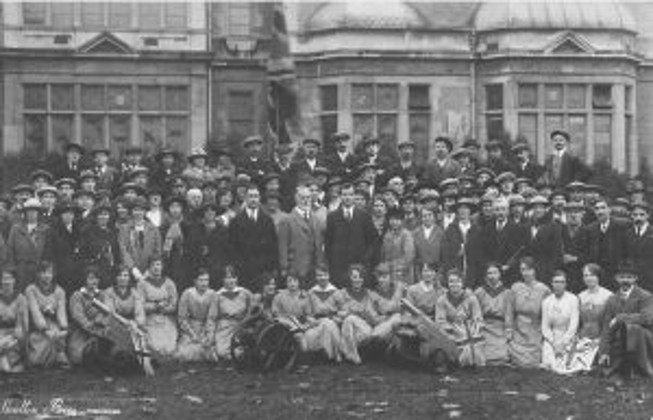
Haden munitions workers Following the First World War, the firm transitioned into a private company in 1919, eventually becoming a public entity in 1921. A significant milestone arrived in 1926 when Haden secured a contract to equip Carliol House in Newcastle with its innovative lower-pressure hot water panel system. This system utilized large thermal storage cylinders with electrical elements, strategically designed to draw power during off-peak hours, demonstrating an early commitment to energy efficiency. The mid-20th century saw the firm continue to expand its services and by 1937 they were recognized as leading heating and ventilating engineers. By 1961, their offerings had grown. It included heating, air-conditioning, piping, and sanitary engineering, encompassing warm and cool air systems and industrial process services. At this point they were employing approximately 3,000 individuals. Despite a dip in profits in the mid-1960s, the company quickly regained its footing. The late 1960s and early 1970s marked a period of strategic acquisitions and consolidation. In 1969, they acquired Troughton and Young to bolster their electrical contracting capabilities. This was followed by the consolidation of their electrical and mechanical engineering activities, including Troughton and Young, into a new subsidiary, Haden Young, in 1970. The same year saw the acquisition of Carrier Engineering Co., further broadening their expertise. Haden Young secured significant contracts, including one in 1971 for air conditioning, heating, and fire protection in an 18-story building. Reflecting these strategic expansions, the company officially changed its name to Haden Carrier in 1971. The company’s journey under this name continued until 1986, when it became Haden Building Services Ltd. The company was subsequently sold to Balfour Beatty but remains listed under the original name with Companies House as “Active”. In the 1990s, the company played a pivotal role in the construction of the Channel Tunnel, cementing its legacy in major infrastructure projects. To this day there are visible signs of the Haden family's influence in and around Trowbridge. A stained glass window dedicated to the memory of George Haden can be found in the Tabernacle Church (now converted into residential flats, but with the Church and its stained glass window remaining preserved). Until 1974, Trowbridge’s Clarendon school was known as the Nelson Haden School. …… and of course, in 1939 William Nelson Haden presented the Bandstand in the Town Park to the town. Return to HOME |
||
|
About the Friends of Trowbridge Bandstand: |
About the Bandstand itself: |
|
|
|
|
|
|
FoTB Documentation. The FoTB is governed by a written Constitution and relies on documented Rules and Policies that dictate how we operate. All our documentation is ISO9001 compliant. You can view the most recent versions of our documentation by clicking HERE. |
Past and present images of the Bandstand Click HERE to view a selection of old and new images of the Bandstand. Do you have photographs of the bandstand, either past or present, that you'd like to share? If so, please send them to us at admin@fotb.org.uk |
|
|
The Friends of Trowbridge Bandstand has applied to the Charity Commission for England and Wales for registration as a charity under the Charities Act 2011 (Application number: 5294277) |
||